Twitter Report

It’s been about a month since I dipped my toe in the Twittery waters and I still don’t quite know what to make of it. Statistics tell me that traffic to my personal Web properties has increased rather dramatically. That’s a good thing, right?

I should mention that I quickly learned that there’s little/no restriction on creating new IDs, and it’s very useful to do that in order to experiment with stuff. It’s nice that they allow you delete your ID, too, so if you play that way it’s just nice to clean up when you’re done. That dopey ID you made for testing might be the one someone else is seeking.

So let’s take a look at few Twittery things I’ve noticed, shall we?

Tools Twitter’s API is lots of fun to play with. There’s so much you can do with it and zillions of folks are hard at work trying to figure out how their pet hack can bring them fame, fortune and, yes, money. I’m not at all crazy about the hosted tools that need you to enter your credentials before they’ll function. It’s a trust thing. (Test IDs can come in handy here.)

Advertising Like everywhere else on the Web, everybody’s trying to sell you something. The current worldwide economic climate has spawned a kind of desperation that’s driven some to every imaginable online get-rich-quick scheme. And Twitter’s incredible popularity and growth attracts ‘em like poop attracts flies. In fact, there are more Twitter users expounding on how to make money with Twitter than you can shake the proverbial stick at!

Loneliness There’s an air of sadness, loneliness, melancholy. I can’t quite put my finger on it, but it’s definitely there.

Celebrity Lots of celebrities of all levels are on Twitter. Some are even personable and cool. You’ve really gotta take it with a grain of salt, however. Who’s real? Sure, it’s uncool to impersonate, but uncool isn’t a crime. Who’s got staffers writing for them? Who’s just there for shameless self-promotion?

Risk Many tweets include URLs, and most of them have been shrunk to fit the 140-character space using one of the many URL-shortening services. Unless you take steps to preview – and it seems like nobody does – you just don’t know where you’ll end up. And that can be double-plus-ungood. You really need good client-side defenses – you just know you’re gonna end up clicking that link.

Twitter reminds me alot of the CB craze back in the ’70s (when dinosaurs roamed the Earth). This time around, though, you get the fickle tides of Internet trendiness instead of an 11-year sunspot cycle to interrupt the fun. (Internet trendiness is not unlike that surging feeling in your stomach as your Scrambler car changes direction, or the wave pool at Typhoon Lagoon on a hot Wednesday afternoon.) Technically, there’s nothing really new here; all of the technology behind Twitter has been around for quite a while. Doesn’t matter, its popularity is on fire now, and the big question is how it’ll make money. I’m not going to speculate.

I’ll leave you with this cartoon. It’s silly, but it also pretty much sums it up.

Grocery

I hate grocery shopping. I’ll try just about anything to minimize the time I waste in grocery stores. So I was delighted when I recently encountered Stop & Shop‘s new Easy Shop system. (ed. 13-Mar-2009: The system is called Scan It!, not Easy Shop, in our area.)

All you need to do is swipe your customer card at a kiosk, pick up a hand scanner (ergonomically designed, high contrast color screen, made by Motorola), collect a few empty bags (paper or plastic or, for you greenies, use your own reusable bags) and go hit the aisles. Scan your items as you shop and load your bags the way you want them loaded. Along the way, the scanner periodically spams you with relevant special deals that might interest you. And when you’re finished, the scanner quickly uploads its list to the register. A quick credit card transaction and you’re out the door!

Naturally I was interested in what others had to say about the new system, and I wasn’t surprised to find that many (most?) don’t like it. After all, out here on the Web we love to complain! (Google “Stop & Shop” and “Easy Shop” and see for yourself.) One of the big complaints seems to be that it would put cashiers out of work. Do you really presume to think that by assuming a tiny bit of inconvenience you can preserve someone’s position? Besides, I love to talk to anyone and everyone and I have not met a single cashier yet that actually likes their job. Other users don’t care for the random audits, feeling like they’ve been singled out. I don’t know what triggers an audit and I’ve only used the system once (no audit), but I don’t know how else they could detect shrinkage or ensure customer honesty.

There is an RFID-based system being developed – I think it’s being tested in Germany – whereby you simply load up your cart and push it out the door. No hand scanning is necessary and your entire order is tallied en masse as you exit, billed automatically to your credit card. It sounds intriguing but I think we’re safe for a while.

Oh and before you ask, yes, I have tried Peapod. The service is well worth the fee, but the product selection is… suboptimal.

Obama-Nation

Oakey-Dokie, then. The good ‘ol USofA now has a new President. So why do I have this sinking feeling in the pit of my stomach? Hold onto your ass with one hand, dear friends, and your wallet with the other; we’re in for one helluva ride.

Holiday Tipping

Even though I’m so immersed into the online world I still subscribe to a pulp-based newspaper. Yeah, yeah, I can hear you snickering right through the wire. I scroll, er, page through it every once in a while but mostly Pam reads it in the morning on the weekend. So we keep a Friday-Saturday-Sunday subscription to the Home News Tribune.

old Home News building

old Home News building

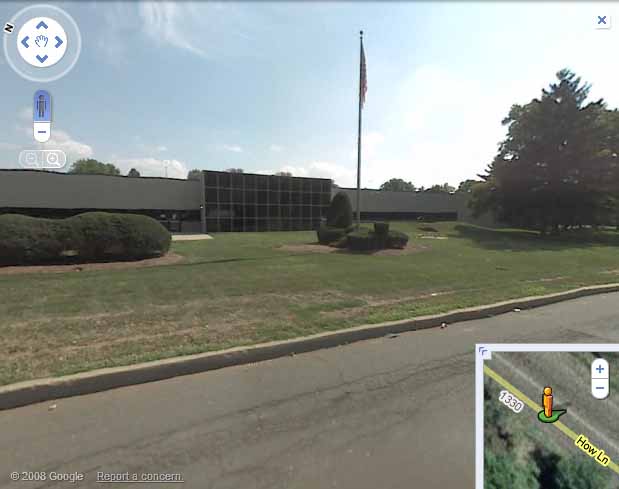
I live in the town I lived in as a boy and this paper has served the area as far back as I can remember. Like almost every other paper, it’s changed hands and merged more times than I can count – I remember it as the Daily Home News. A fun elementary school trip was a tour of their building on How Lane (image) where it the paper was written, printed and distributed. As a kid I sometimes delivered the paper, by bicycle, to the neighborhood, subbing for friends when they were sick or vacationing. (But I never had a route of my own – that coveted job was only for the ambitious and motivated – not me, back then!)

Back in the day, the flow of subscription money was much different than today. The carrier (delivery person) would buy the papers needed to service the route at discount and collect weekly from subscribers, pocketing the difference. Tips, of course, could be a good part of your earnings. As a mini-business you learned about profit and loss, commitment, relationship-building and all that other good stuff.

Today there’s no neighborhood kid or bicycle, just a guy (I think it’s a guy) speeding around in a beat-up car before dawn. I haven’t got the foggiest idea how they’re paid but I get a bill from a faceless entity somewhere across the state (ed. 19-Dec-2009: now it’s Louisville, KY) once a year. On the payment form is a space for a ‘carrier gratuity’. Service has been good over the years – the paper’s always there when I expect it – and so I tend to tip pretty well. Looking back over my records I see it varying between 50% and 100% of the subscription price. The billing office, I’m thinking, distributes the gratuities to the carriers. Subscription renewals come up all the time so there’s probably a steady stream of gratuities. There should be, anyway.

There was an eighth-sheet-sized, ink jet printed request tucked into one of this weekend’s papers – a tip request! It got me to thinking.

Last year there was another request just like this. A couple of weeks later there was communication from the publisher telling of a scam that had been taking place on their routes. The scam worked like this. The fraudster would put notes in the delivered papers – they’re delivered very early in the morning. Then, they’d come by before delivery collecting any envelopes left by subscribers. What a racket, eh? I suppose this would work for any early-morning service: deliveries, trash or recycling collection – heck, everybody seems to expect tips these days.

What do you think? Do you tip off-hours service people this way? Did you ever think that maybe your gratuity isn’t actually going where you think? How many actually get up nice and early to handle it personally?

Business Loss: Is That A Spade I See?

The other morning on the televised news I heard of (yet another) corporate muckety-muck drawing a comfortable salary (USD6M, in this case) despite their company’s recent losses (some USD40B). And it got me to thinking about terminology.

Take the term from which this entry derives its title: ‘loss’. I’m thinking that this is one of the most misused terms around – especially today, as it applies to business and economics. It seems to be deliberately chosen to create a feeling of sympathy for the ‘lossee’, and I think that the feeling is completely misplaced.

Let’s first look at a perfectly accurate usage. “Joey Psychotic lost his home and all of his possessions to fire this morning, believed to be started when his hungry cat kicked over an unattended prayer candle…” This makes sense – Mr. Psychotic had a home. But it was consumed by fire, reduced to a wet, smoking pile of rubble, crawling with investigators. Not a home by any stretch of the imagination. You feel sorry for Mr. Psychotic, and you should (even while questioning his religious rituals).

Now, how about this one: “The Acme Prayer Candle Company lost forty billion dollars over the last three quarters of this year due to slacking demand. Stockholders fear bankruptcy as…” Nope, I don’t buy it. That which you do not have cannot be lost. Acme didn’t lose anything – they never had it in the first place. See the difference?

Let’s take a stab at writing that a little more accurately: ”The Acme Prayer Candle Company failed to realize forty billion dollars in profits over the last three quarters of this year. Acme executives cite slacking demand as the cause of their failure to deliver promised value to stockholders, who fear bankruptcy as…” Acme didn’t lose, they FAILED.

Fail brings a whole different set of emotions than loss. It’s not that failure is necessarily bad, either. After all, failure can be a very powerful teacher – well, provided one can grasp its message, which isn’t a given.

I don’t feel much sympathy toward anyone that can (mis)direct their company to failure, and yet still pull down six million greenbacks. I won’t bet on their learning anything, either, unless it’s something along the lines of, “hey, look what I just got away with!”

Maybe the companies that are failing should be allowed to fail, their directors along with them. A multitude of companies, built on good ideas, managed competently, would certainly spring up in their place. I’m not denying that there would be great steaming heaps of economic pain along the way, the likes of which most alive today have never seen.

But America, still the greatest land on Earth, would emerge stronger than ever.

Products That Just Shouldn’t Be

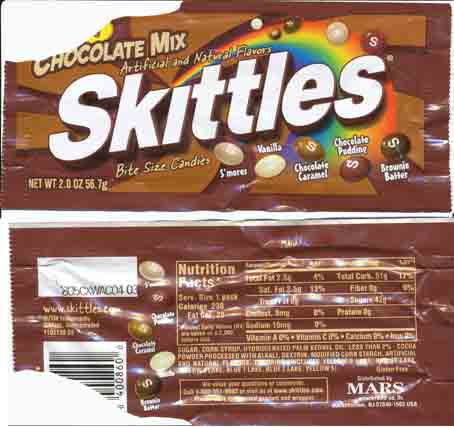
Some days ago we stopped at the supermarket for a couple of things. Standing in the checkout line we saw something new – Chocolate Skittles.

Chocoate Skittles

Chocolate Skittles

Now, I actually like Skittles. Especially the sour ones that are encrusted with that crystalline stuff that stimulate your taste buds not unlike a full stack of Marshalls cranked up to 11 does to your ears. My kid, like 99% of all kids, loves that stuff, too. (An equal proportion of adults hate that taste stimulation, incidentally, which I believe is by design.)

But these chocolate things? Ugh! Gave ‘em to my kid. He gave ‘em back. My wife refused to try ‘em after watching our reaction. ”Tastes like ass.” To say that the flavors in the package – S’mores, Vanilla (huh? vanilla in a ‘chocolate mix’?), Chocolate Caramel, Chocolate Pudding, Brownie Batter – seriously miss the mark is a gross understatement.

Products don’t just spring into being without consideration. Somewhere in Mars there was a meeting, the result being a decision taken to bring these abominations to market. Probably a bowl or two of ‘em right there on the conference table, alongside the coffee cups and water bottles. I wonder if any of the suits actually tasted ‘em. Somehow I doubt it.

Some years back I knew a girl that worked for Mars. She said that samples from their (rather extensive) product line were freely available in all their offices. I’ll bet the bowls of these never, ever need to be refilled.

“Saved By Zero”

Toyota earns a fat zero in my book for that awful ad campaign they’re running with that tag-line.

Over and over and over again. Oh, I’m so sick of hearing it. And besides, what with the economy in the toilet it’s just what the weak need to hear: a pitch for a zero-percent loan to buy something so stupid as a car. Wake up, people. Do you really think a corporation is going to let you borrow their money for free? Oh, you’ll pay, one way or another. And that’s something you can take to the bank.

As for me, I’ll need to long-forget that abysmal ad before I’ll even consider buying anything from Toyota.

The Death of the Blog? I Don’t Think So

The other day I read the WIRED piece by Paul Boutin where he tells us that blogs have passed into obsolescence. I’ve got no disagreement with many of Paul’s points – the rampant commercialism, the decline of text as a medium of expression, and so on. Who can compete with legions of professionals? But is that really what it’s all about?

I don’t see much difference between the basic evolution of blogs and the basic evolution of other forms of expression. Blogging started small, just ordinary folks with something to say, and the development of tools to make it easy for the non-technical (or less-technical) to reach the world. Some producers became popular and the money started to flow. Traditional media, their livelihoods threatened (yet again), jumped into the fray. Followed by legions hoping that they could finally get rich quick. Blogging exploded.

Today there are countless blogs, far too many for anyone to keep track of. Every one can’t be at the top of a Google search. Not every one can generate scads of revenue. Not every one can be the most popular. Is your blog on the top 100 list? Nope, mine isn’t either. But honestly, that list is the last place I go for stuff to read. How about you? One thing I’ve noticed that the usefulness, the interestingness, of a blog is inversely proportional to its sponsorship and associated advertising. See those sidebars, bulging with beckoning animations and such designed to siphon your wallet? But that’s just me.

No, the blog is not dead. It may smell a little funny, but that’s okay. Keep reading. But, more importantly, keep writing.